[15 min read + Time for Exercise]
The idea of what high performance means and how we can cultivate it is something I’ve spent a lot of time investigating and reflecting on. It’s a common thread in discussions I have with peers and also with those I’m mentoring. More recently, it’s being debated in a world where people’s relationship and expectations of their work is evolving and being challenged.
This post aims to help decipher part of the high performance puzzle, by exploring the power to be gained from bridging the gap between your personal values and life in business. I hope to leave you with a method which helps you along a path to achieving this.
Through the access I’ve had to high performing individuals over the past 10 years, along with the broader patterns I’ve observed in my pursuit of answers, I’ve been able to design a mental playbook for high performance. The basis of this model is around identifying and leveraging our unique values and purpose.
This is in many ways the b-side of my TEDx talk, and an extension of the work that went into it.
The Foundations of Our Capabilities
We find inspiration from stories of humans pushing boundaries, breaking records or making the impossible possible – be they athletes, leaders, artists, entrepreneurs or even our family and friends. However, for many of us, our own experience of finding a path which will drive us to do the same can sometimes be hard to carve out.
Ultimately, when we talk about high performance, we are talking about capabilities. Capabilities as measured against goals in a given field of application. How capable are you? This is not an easy question to answer, especially when we default to comparing ourselves to others as an arbitrary measure. We can cut this question many ways, however the best way of think about this is as a measure of the extent to which we are effective at delivering on that which we are uniquely capable of. Of course, for this to be possible, we need to get clearer on what makes us unique, and I hope to help you do this through an introspective exercise at the end of this post.
There are any number of factors which are statistically proven to best predict the likely outcomes of our lives. To name but a few, they include the quality and level of your education, the socio-economic demographic into which you were born, your relationship with your parents and whether you had a two parent or single parent household. You can read a study by the Social Mobility Commission here, which goes into depth on the critical drivers of social mobility.
Over the years I’ve worked with, and observed, a number of organisations which seek to overcome equity disparity through structural or cultural changes within organisations and society. When I reflect on the work done in this area, and consider the endless number of programs like this which exist today, there is a part of the conversation which I’ve never personally seen mentioned. This is the conversation around values and purpose.
In a more recent report by the same Commission titled Childhood Origins, we discover some (be it of limited scope) research on how parental values and expectations of children vary across a number of socio demographic variables.
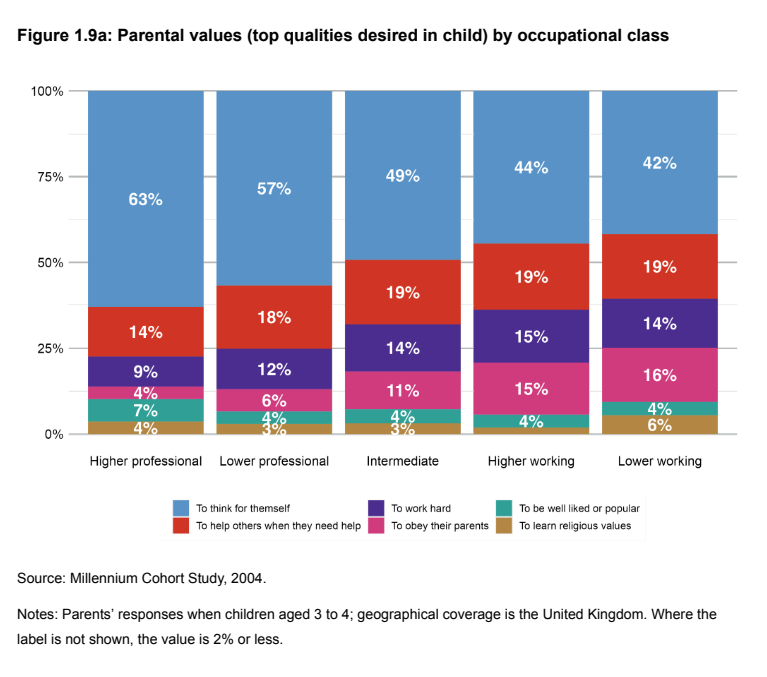
Make of the research what you will, the meta point is that the values imparted upon us will have a bearing on our life outcomes. The so what? of this, is that identifying and aligning to the values which best represent our innate purpose and unique selves is the way to identify and harness our unique capabilities. When we do this, our values act as a force which can overcome any limitation or probable statistical outcome of our circumstances which we are categorised by.
I have reflected on how I or generations of my family would be labelled in a census or in the aforementioned study, through the lens of terms such as ‘occupational class’ or ‘educational level’. In 2020 I wrote about my cultural identity and lineage, what it meant, and my questions around my duty to its future. I’ve thought about how my cultural identity informs who I am and also how this reflects in the way I approach my work. Cultural identity is of course one of many inputs that make up who we are. Having each of our unique ingredients acknowledged and included is often seen as an important part of creating equality of opportunity (a fair starting line). The logic underpinning this being that by identifying diverse attributes we can ensure related biases or blockers can be addressed. This all makes sense, however we must move the conversation along and talk about how an equal starting line is as it describes, only the start. To extend the analogy, we also need to focus on how we can improve performance on the track once the whistle blows.
Values Find Their Roots in Your Past, and Determine How Your Life’s Tree Will Grow
“How you do anything is how you do everything” – To me one of the best articulations of our values show up in life.
Can you give a clear answer if someone was to ask you what your values are? They show up in every aspect of your life. They inform how you treat the waiter at a restaurant, how willing you are to learn about people different from you, how you react when things go badly, how you make people feel and how those people remember you. Values find their roots in a tangled web of your innate nature, your childhood, your culture, the environment in which you were brought up.
It’s important for us to acknowledge in the discussion about values the relevance of formative life experiences. With this being such a personal topic, it usually doesn’t make its way into discussions we have at work with teammates or when we hire people – but the criticality of its connection to your personal values makes it an important part of what we need to start talking about more openly. Our experiences connect directly to who we are, which translate over into how we navigate the world, and deep and conscious awareness of this can bring significant benefit.
I have a few favourite examples of this in action.
I recently watched an interview with Gordon Ramsay, in which he spoke about how his drive to succeed was shaped by his childhood experiences. Primarily, how coming from a disadvantaged background made him feel lesser than other kids at his school, but also spurred him on after he witnessed his mother’s actions to provide the best for the family. This was the source from which he derived his values, deeply connected to who he is today, and how he goes about conducting himself.
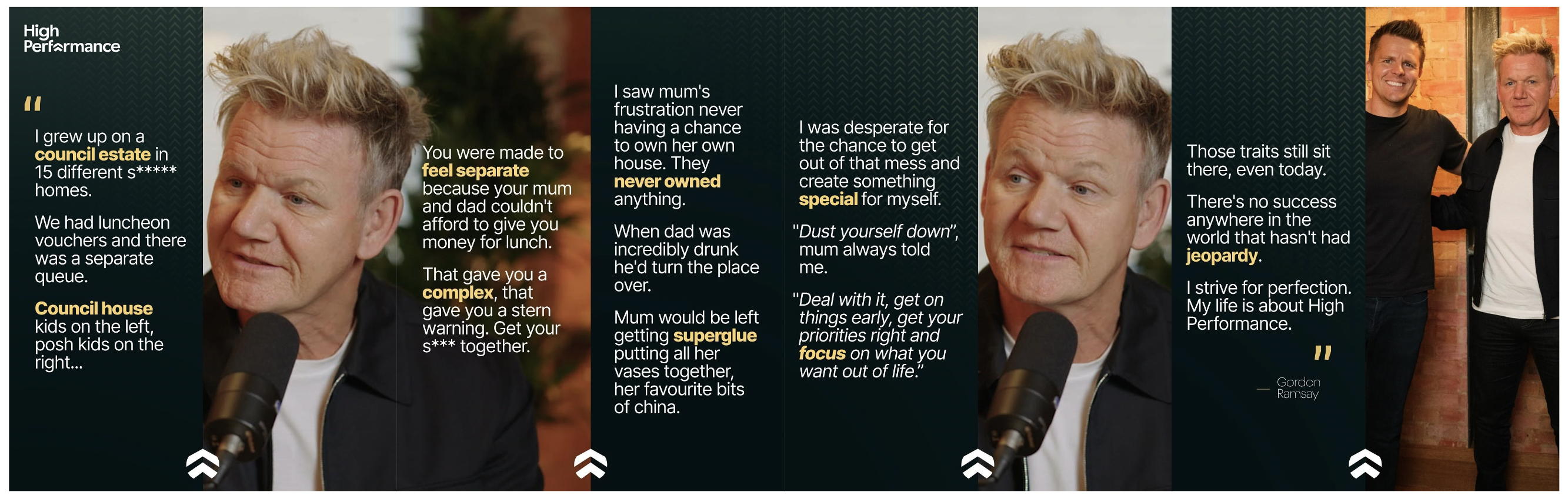
Gordon shared an anecdote about the segregated lunch queue in his school, which existed for pupils with luncheon vouchers, many of whom came from council estates. It made me remember my own experience in primary school, where pupils with packed lunches were made to eat lunch in a cold and damp wooden mobile building on the edge of the playground, instead of in the main lunch hall. My mum ran a campaign to have this changed, organising a petition which was signed by parents and given to the school governors, in order to ensure we were not side lined and made to appear less worthy than other students. Events like this in our lives are important influences on our character. As is the case for us all, this experience was one of many which I have vivid memories of.
My two brothers and I were the only pupils who attended our primary school in plain jumpers, missing the school emblem – as our family were unable to cover the cost of the official school uniform. After school and on weekends, we would go to my parents’ warehouse from where the family business was run – a business which was started in the mid 90s in our living room. I remember being around 6 years old, sitting with my family around a box of socks, which my dad purchased with borrowed cash to start the business. I remember the coin gathering exercise we undertook before going to co-op, and the family tension that came with those circumstances as we tried to claw ourselves back.

After arriving as refugees from East Africa in 1972, my parents settled in Leicester after being initially housed in empty military camps. There were some 30,000 similar to them, deemed imperial subjects and granted a passport under ‘United Kingdom & Colonies’ in return for their services to the crown (supporting the labour that built the East Africa Railway for the British). They met in the 80s and had three children in the 90s. Shortly after this photo, our lives took a turn for the worse. We lost the pictured house located in a sleepy village, and had to start over again (a second time) from financial ruin.
When I consider how my own values were developed and how they translate into my work, they are fundamentally connected to these life experiences. My own experience of business is one which was started out of observing our family trying to survive. Rooms in our home were filled with piles of boxes up to the ceiling, and rails of clothing you had to navigate on the way to the kitchen. Weekends were spent packing clothes and visiting factories to buy more stock. ‘Hustle’ was in our blood.
Our values were formed around a duty to contribute to supporting the upkeep of the family. This premise of holding a sense of duty as a core responsibility and required service, actually shows up in many parts of Indian culture, finding roots in the Bhagavad Gita, most clearly in Chapter 2 verse 47 – something that is popularly cited in the Indian school system and shapes the nation’s culture.
कर्मण्येवाधिकारस्ते मा फलेषु कदाचन
मा कर्मफलहेतुर्भूर्मा ते सङ्गोऽस्त्वकर्मणि
karmaṇy-evādhikāras te mā phaleṣhu kadāchana
mā karma-phala-hetur bhūr mā te saṅgo ’stvakarmaṇi
You have a right to perform your prescribed duties, but you are not entitled to the fruits of your actions. Never consider yourself to be the cause of the results of your activities, nor be attached to inaction.
We heard Rishi Sunak speak of this openly during his prime ministership.
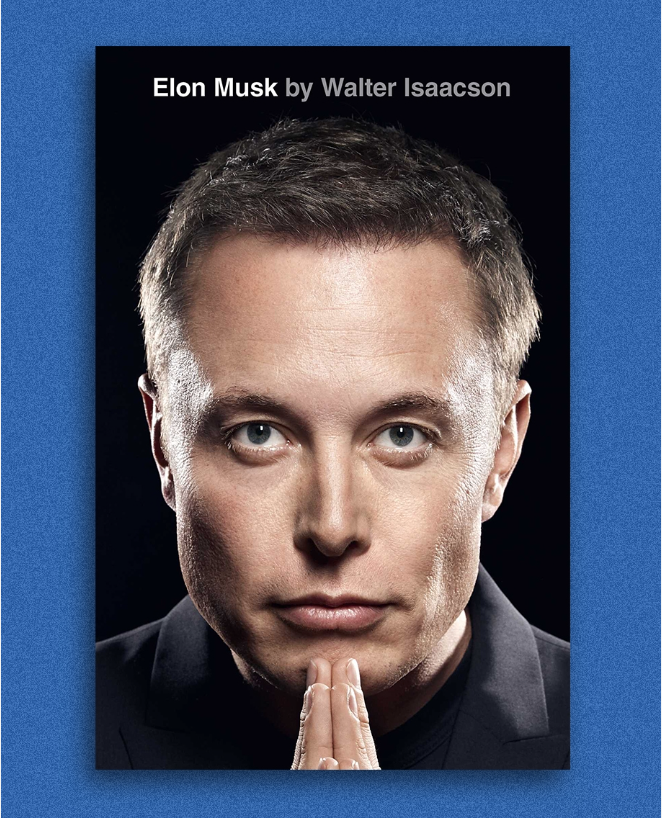
Continuing the thread of how life experiences inform values, another example worthy of citation is that of Elon Musk. His biography, written by Walter Isaacson tells the stark tale of his childhood in South Africa, something which involved shocking violence and abuse at the hands of his father. As Walter described, Elon grew up with his father exercising an extremely stern streetwise autocracy with his children, which entailed him undertaking absurd acts like forcing them into fights with other children.
As cited by his biographer and through interviews with family, there is a dotted line between those harrowing childhood experiences for Musk, and the autocratic style which he now brings to his leadership. This, being but one factor which lingered in his psyche despite his best attempts to shake it off. Included alongside it, was how the impact of his childhood and troubled relationship with his father led him to close down emotionally, making him by all accounts a callous individual. He shut down joy and empathy, and alongside it removed fear, whilst building an aversion to contentment – unable to smell the flowers when success finds its way to him. In Musk’s own words:
Adversity shaped me, my pain threshold became very high
It’s no surprise then, that this combination of sharp elbows and industriousness translate into his work. In an interview for a BBC documentary, one of the recruiters at SpaceX was asked what it means to work there. She said- “SpaceX is like Special Forces, we take on missions that others have deemed impossible.”
As you’d expect, the same is true at Tesla Motors, and during an interview with Autoblog Musk commented that: “The general understanding is that if you’re at Tesla, you’re choosing to be at the equivalent of Special Forces. There’s the regular Army, and that’s fine, but if you are working at Tesla, you’re choosing to step up your game. And that has pluses and minuses. It’s cool to be Special Forces, but… it’s not for everyone.”
This important context provides the backdrop of meaning behind how Elon runs his companies, and how he shows unparalleled ability to overcome the odds. Its this set of values, when combined with his innate intellect and technical ability which has spurred his success – the two pieces being equally as important.
His focus on practical truths and efficiency can often lead him to controversy, such as the well publicised firing of 80% of Twitter employees upon his takeover of the social media giant (which he undertook in a very matter of fact way), or his later comments towards advertisers on the platform. His stark belligerence for a high bar of efficiency also shows up in his ambitions for creating a Department Of Government Efficiency aka D.O.G.E (a name play on a popularised cryptocurrency) – something now being actualised ahead of the pending administration change in the USA.
Judge these stories as you will, for good or for bad. The key takeaway is the importance of understanding how our experiences shape our values, and how our values have a disproportionately high impact on how we undertake our life’s responsibilities.
Practically Connecting Values to Business
So, if we acknowledge there is a link between our values and our work, and some benefit to be had from bridging this gap, how can we go about defining this connection more clearly?
Well, if an organisation exists to deliver on a vision, the extent to which you are capable of delivering outcomes aligned to achieving that vision will be determined by-
– How effective the collection of activities you undertake are at delivering desired goals (dependent on a strategy and set of activities which best align to achieving the vision)
– How much effort you can generate yourself and through other employed resources (level of input injected into the activities)
– The extent to which you can effectively deliver the outcomes for each respective activity as efficiently and impactfully as possible (executional excellence)
This is a gross oversimplification of what is explained very well by Michael Porter in his famous essay ‘What is strategy’. So where do your values fit in? Simply put, if you can effectively identify and align your values to the activities you are undertaking, you can lay the foundations for you to deliver outsized results.
What’s more, by acutely aligning your values in this way, you create a level of fulfillment that helps you meet the bar for self actualisation through your work. At this point, your input effort is maximised, as you are working towards an outcome that pays dividends on your ability to experience meaning through work. This creates a loop which continually spurs you on as you see results and find meaning from following the path of your values.
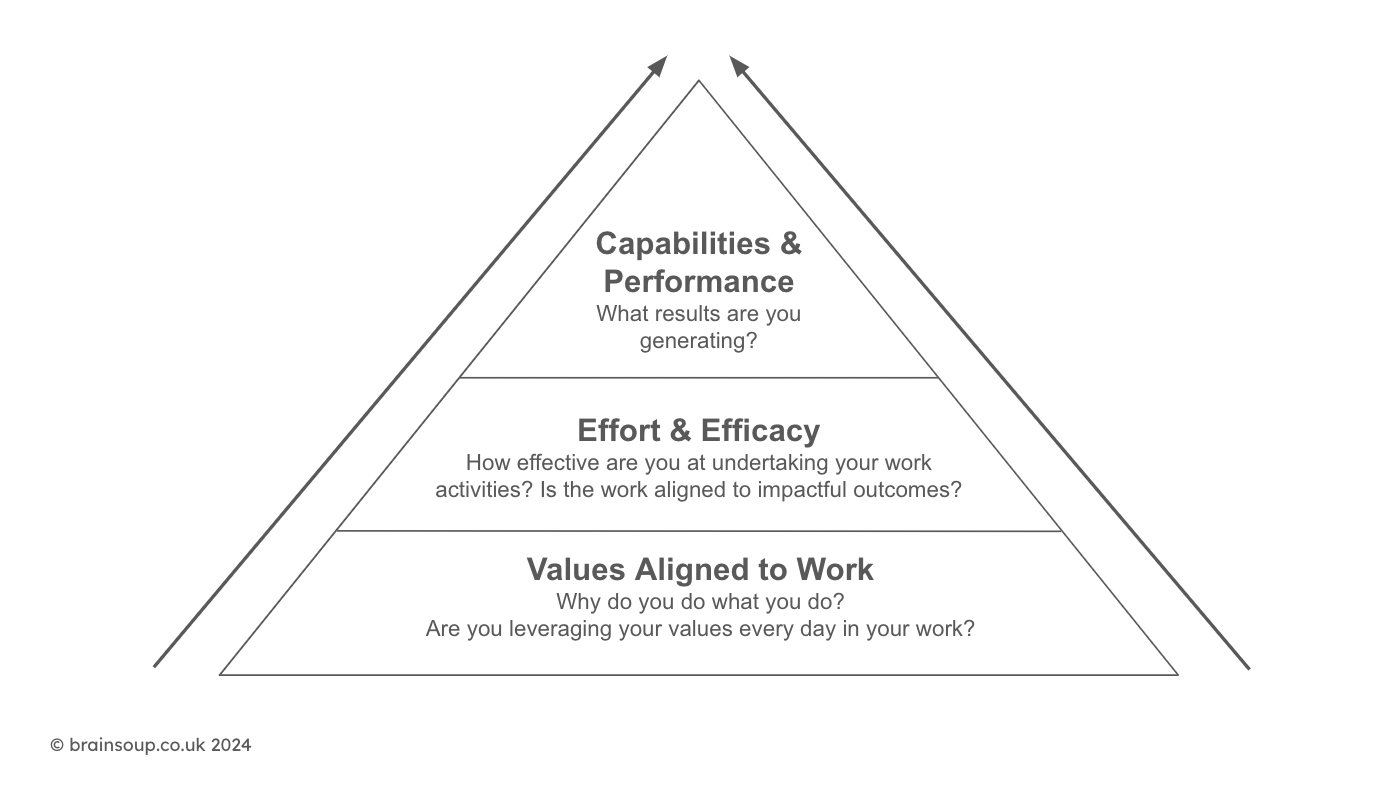
It is of course possible to generate strong capabilities and high performance by soley employing significant effort and being effective at what you do. But to derive fulfillment and meaning from what you do, and have the endurance and resilience to outpace others, or to keep going when things get tough? This to me can only come from your values being engaged.
Why Leaders Should Tap into the Values of Their Team
Making a conscious and intentional effort to understand the values of individuals in your team, and seeking to align their prescribed scope of work to these values is an extremely powerful way of building a high performing team. As you would consider the uniqueness and relevance of someone’s skills and experience to undertake a job, understanding that everyone’s values impact their work and that there is no one-size fits all version of this, is a critical part of setting people up to deliver high performance.
A front line customer facing role requires values of compassion, which manifests as a strong desire to help others and to see them be happy/delighted. Solving your businesses’ most difficult problems not only needs intellect and experience, but also values underpinned by an unshakeable drive to overcome difficulty, with the resulting grit to persist to an outcome. Finding the answer to a highly technical problem not only requires the appropriate aptitude, but values of thoughtfulness and patience, and therefore the willingness to work for an extended period with no instant gratification.
Identifying your own values, as well as your team’s, is a worthy investment of time. It’s what I hope I can help you make a start on.
Exercise: Values Reflection
Step 1: Expose The Roots
Identify and write down three of your most formative experiences. These might be in the form of-
| Category | Description |
|---|---|
| Inspiring Experiences | Revelations that sparked lasting passion |
| Standout Memories | Moments when happiness was at its peak |
| Negative Feelings | Experiences related to trauma or distress |
| Emotional Encounters | Significant reactions to people or places that left a strong impact |
| Moments of Certainty | Times when you felt assured and secure about your identity |
My example-
- Growing up working in a family business, from the earliest age I remember the toil of hard physical work and spending evenings working with my parents.
- Reading Muhammad Ali’s Soul of a Butterfly aged 14, something which opened my eyes to someone who became the most impactful influence in my life
- Working for an NGO in Uganda, which gave me a unique perspective on the world and gave me work that I enjoyed
Step 2: Identify Their Effects
For each of these experiences, write a corresponding sentence as to why they impacted you so much and why they may be important, this might include-
| Aspect | Description |
|---|---|
| How it made you feel | Reflects the emotions and internal experiences triggered by the event or influence. |
| How it changed your perspective or shaped you | Describes the transformation in thought patterns or beliefs resulting from the experience. |
| The lessons it taught you | Highlights the key takeaways or insights gained from the event or influence. |
| How it influenced the direction of your life | Illustrates the ways in which the experience altered the course of your life or future decisions. |
My example-
1. Taught me the value and importance of taking on the burden of responsibility, no matter how heavy it may be
2. Showed me an example of how to live without limiting thoughts, and gave me the licence to do the same
3.The first time I demonstrated to myself that I can have a meaningfully positive impact on other people’s lives
Step 3: Use Them as Fuel
Make a list of thing you have done which make you feel most fulfilled
My example-
1. Pursuing sports – playing cricket afterschool or later in life boxing/strength training
2. Working in a team of volunteers in Kenya supporting entrepreneurs
3. Building anything with my hands (repairing furniture, fixing my car etc)
4. Taking something from an idea into reality
5. Coaching and Mentoring
Final Step: Find the Common Themes
There should be some dotted lines between what you have for step 2 and step 3. The aim is not to have them pair up perfectly, but to tease out the underlying themes. You’re trying to draw the link between how your formative experiences shaped you and what is now important to you.
For me, the connections are;
– Seeing value in taking on responsibility and being prepared – which is the likely fuel for my self development and push for physical training/being a hands on person
– Learning to exist without limiting thoughts – which informs why I enjoy taking on challenges and making ideas come to life
– Realising that we all have the power to change lives, and finding joy in doing this through coaching/mentoring
There may only be one connection, or multiple connections but with one theme. There is no fixed rule for the outcome of the exercise. The goal, once you have done it, is to then turn it into a statement which describes your unique set of values. Something like-
My values are built on a calling to take on responsibility, and help others to realise their true potential. I do this by living with a no-limits mindset, with a focus on inspiring self improvement, which I enact upon myself as well as teach to others. This helps me to bear the burden of any challenge without falter, and motivates others to do the same.
With your statement complete, you should be able to use it as a lens through which you can view your work. It should be the measure that you use to determine whether what you are doing is aligned to your purpose and your ability to reach your true potential. Consider how you can leverage the power of this statement to create value for others – it’s likely that this statement defines you at your best, and is the articulation of your unique superpowers.
Your values will only be powerful if you are willing to use them
Your ability to leverage your values will only be successful if you have no fear of applying them. This is what authentic leadership looks like – and it requires a degree of courage and the removal of fear of judgement from others. We see this often, where unconventional leaders (usually the authentic ones) are shunned by those who lack the ability or willingness to appreciate differences, focussing instead on rewarding homogeneity – the surest path to mediocrity.
The question of how we can balance and control our biases to support the needs of those around us is a critical part of dynamic leadership, and for now, is a post for another day…


 Brain Soup